

The Palmkin Principle: What a Small Pumpkin Teaches About Product Thinking
A story of how a small hybrid pumpkin reflects decades of agricultural refinement—and what it teaches us about product design, optimization, and evolving in an AI-driven world.

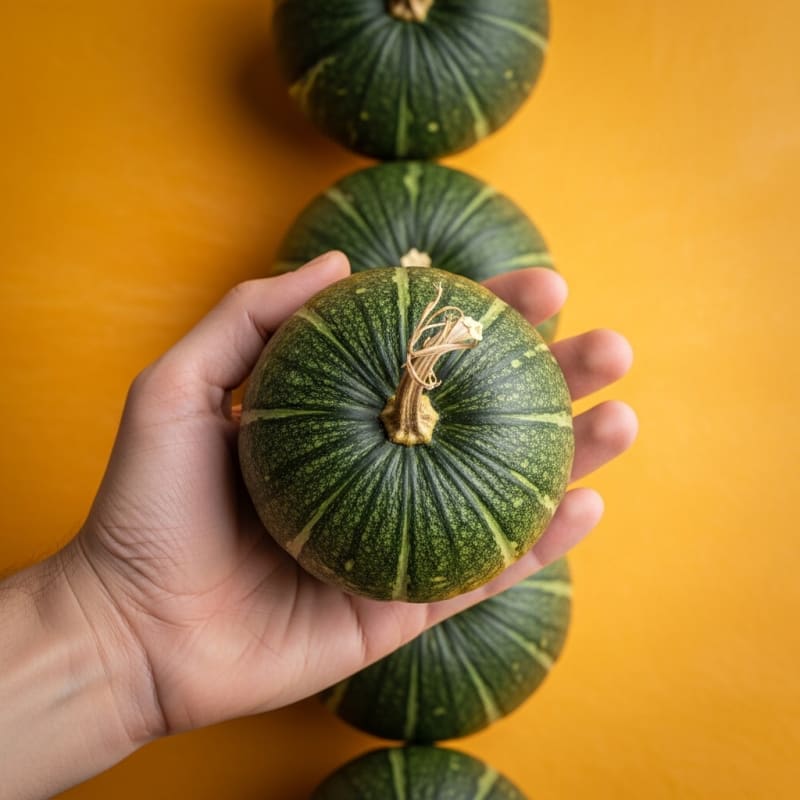
At first glance, it’s just a small pumpkin.
But if you look closely, it represents something far more interesting:
how thoughtful refinement transforms something ordinary into something exceptional.
This is a Bei Bei pumpkin — a modern hybrid in the kabocha squash family. And like many great products, it wasn’t created in a single breakthrough moment. It emerged through years of iteration, cross-cultural influence, and user-focused improvement.
A Brief Origin Story
Pumpkins and squash trace their origins back to the Americas, where they were cultivated for thousands of years. Over time, these crops spread globally, eventually reaching Japan.
In Japan, something different happened.
Instead of optimizing purely for yield, Japanese agricultural practices emphasized:
- Taste (sweetness and richness)
- Texture (dense, smooth flesh)
- Consistency (predictable quality)
This led to the refinement of kabocha squash, known for its naturally sweet flavor and compact form.
Later, modern agricultural companies built on this foundation. Through controlled hybridization and selective breeding, they developed premium mini varieties like the Bei Bei pumpkin—combining:
- Japanese kabocha genetics
- Global breeding expertise
- Market demand for compact, high-quality produce
From Bigger to Better
Traditional squash varieties were often:
- Large and difficult to store
- Inconsistent in taste and texture
- Not optimized for small households
Modern hybrids like Bei Bei represent a shift in thinking:
Not “how do we grow more?”
But “how do we make this better for the person using it?”
Every characteristic is intentional:
- Size → Easy to carry, store, and handle
- Portion → Ideal for one or two people, reducing waste
- Taste → Naturally sweet and reliable
- Texture → Dense and perfect for cooking
This is user-centered design, applied to agriculture.
Design Thinking Beyond Software
When you zoom out, the pattern becomes clear.
This is the same thinking used in great products:
- Understand constraints
- Design for real behavior
- Reduce friction
- Optimize the full lifecycle (buy → use → discard)
Agriculture, in this sense, is just another form of product development—
with a much longer feedback loop.
The Palmkin Idea
There’s something symbolic about a pumpkin that fits perfectly in your palm.
Not oversized. Not inefficient.
Just right-sized for real life.
Call it a Palmkin.
A small shift in form—but a big leap in usability.
A Broader Reflection
We’re now living in a world being reshaped by AI and technology at a similar pace.
The same principle applies everywhere:
- Products are becoming more precise
- Systems are becoming more efficient
- Expectations are becoming higher
And just like this pumpkin, evolution is no longer optional.
The things that succeed are not the biggest.
They are the ones that are most aligned with how people actually live.
Final Thought
Innovation isn’t always about creating something entirely new.
More often, it’s about: refining, reshaping, and rethinking what already exists—until it fits perfectly.
Sometimes, the best example of that
is sitting quietly in the palm of your hand.
References & Sources
- Food and Agriculture Organization (FAO) – History of squash and pumpkin cultivation
- National Agricultural Research Organization (Japan) – Kabocha breeding and crop improvement
- Tokita Seed Company – Development of hybrid squash varieties including mini kabocha types
- USDA Agricultural Research Service – Crop breeding and hybridization principles
- Journal of Horticultural Science & Biotechnology – Studies on Cucurbita (squash) breeding and quality traits
Slow down!
You've posted 3 comments this session. Come back later!
