

The 'AI Slop' Backlash: Why Audiences Are Craving Raw Human Imperfection
AI-generated content has flooded the internet, but the data shows audiences are pushing back. Human imperfection is now a measurable competitive advantage.

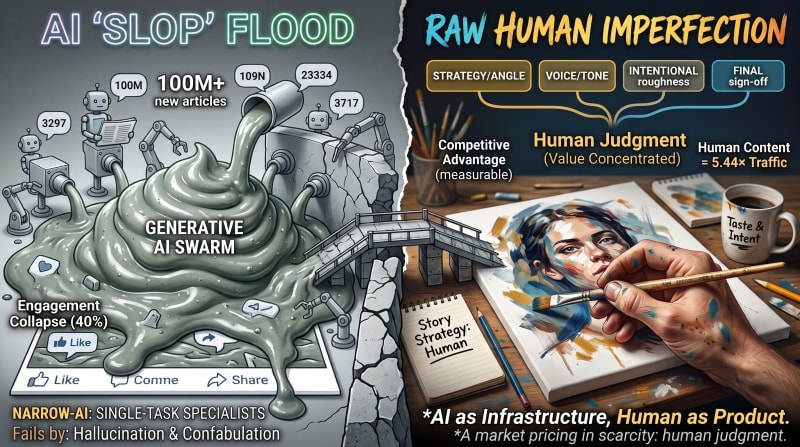
The term “AI slop” entered mainstream vocabulary in August 2024. By October 2025, negative sentiment around it peaked at 54%. Mentions grew ninefold in a year. This isn’t a cultural mood — it’s a market signal.
The Numbers Behind the Backlash
Volume saturation. More than half of all new English-language articles published online are now AI-generated. The crossover happened in November 2024. Stanford’s 2026 AI Index confirms: over 50% of web traffic is no longer human.
Engagement collapse. Olin Business School researchers found engagement with AI-generated articles dropped roughly 40% in 2024. NP Digital’s analysis of 500 companies (2020–2025) shows human-generated content earns 5.44× more traffic than pure AI output.
Trust erosion. 54% of Americans report experiencing “AI fatigue” — the sense that content was generated without human judgment. Audiences who detect AI involvement are measurably less likely to trust, click, or convert.
When Brands Get Burned
The backlash has teeth. Three high-profile pulls in 18 months:
- McDonald’s Netherlands (Dec 2025): AI-generated Christmas ad labeled “slop” within hours. Pulled in three days. The company called it “an important learning.”
- Paramount Pictures (Mar 2025): Novocaine Instagram promo used AI scripting and narration. Criticized for robotic voice indistinguishable from spam farms.
- A24 (2024): AI-generated movie posters sparked creator outrage. The studio walked it back.
These aren’t edge cases. They’re signals that undifferentiated AI output damages brand equity.
Platforms Are Building Defenses
WIRED reported in August 2026 that platforms are rolling out labeling, flagging, and banning tools for AI-generated content. The infrastructure to filter slop is becoming native to distribution. Distribution that once amplified everything equally will increasingly discriminate.
The Hybrid Advantage
The winners aren’t “human-only.” NP Digital found AI-assisted + human judgment outperforms both pure AI and pure human by 43% on engagement. The model: AI as infrastructure (research, drafting, formatting), human as product (judgment, taste, intentional imperfection).
Creator analytics from 2026 back this: content with deliberate human imperfection — rough edges, personal voice, visible process — outperforms “perfect” AI output by 40–60% in dwell time and shares. Imperfection is now a trust signal.
Operational Takeaway
If you’re building content systems in 2026, the question isn’t “AI or human.” It’s: where does human judgment create disproportionate value?
- Strategy, angle, story selection → human
- Research synthesis, first drafts, formatting → AI
- Editing for voice, inserting intentional roughness, final sign-off → human
The slop backlash isn’t a trend. It’s the market pricing in scarcity. Human judgment is the scarce resource. Build systems that concentrate it where it compounds.
Sources: Wikipedia “AI slop” timeline; WIRED “The AI Slop Backlash Is Actually Having an Impact” (Aug 2026); BBC “AI ‘slop’ is transforming social media” (Feb 2026); New Yorker “The Year in Slop” (Dec 2025); NP Digital / Neil Patel “AI vs Human Content” (Jul 2026); ListenFirst Media “AI Slop: When the Internet Drowns in Synthetic Junk” (Jan 2026); Nurdd.club “Made by Humans” benchmarks (Mar 2026); CrossGlobal Marketing “Anti-AI-Slop Trend” (Aug 2026); Stanford AI Index 2026; MIT Sloan ME “Human Judgment Becomes Competitive Advantage” (Apr 2026).
Slow down!
You've posted 3 comments this session. Come back later!
