

Beyond the Hype: The Crucial Structural Differences Between AI and AGI
Current frontier models are wide narrow intelligence, not proto-AGI. The gap isn't compute—it's architecture. Here's what structural AGI actually requires.

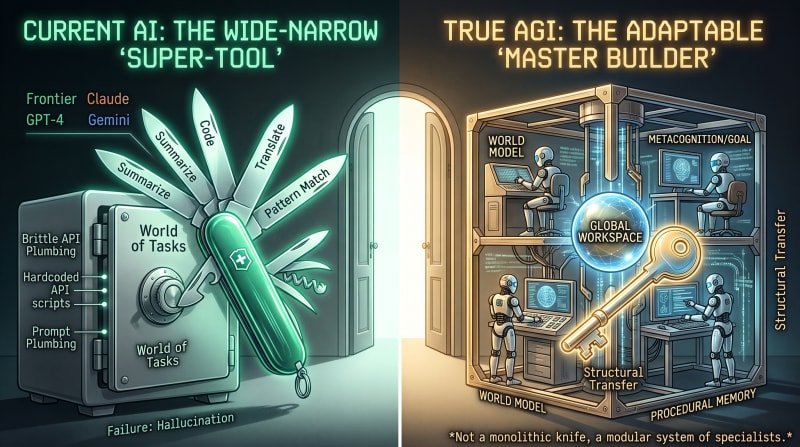
The industry keeps calling GPT-4, Claude, and Gemini “AGI-adjacent” or “early AGI.” They’re not. They’re wide narrow intelligence — single monolithic networks that pattern-match across a broad training distribution. The structural gap to AGI isn’t more GPUs or more tokens. It’s architecture.
Monolithic vs. Modular Cognitive Architecture
Today’s LLMs fuse perception, reasoning, memory, and action into one giant weight matrix. There’s no separation of concerns. Cognitive architectures that researchers agree could support AGI — LIDA, SOAR, ACT-R, Global Workspace Theory — all share one principle: modular, independently trainable components with a global workspace.
- Episodic memory (what happened when)
- Procedural memory (how to do things)
- Semantic memory (facts and concepts)
- Attention/broadcast phase that selects what enters the global workspace for action selection
LLMs have none of this. They approximate memory through context windows and weights, but there’s no grounded, updateable world model — just statistical associations.
No Persistent World Model = Hallucination by Design
A structured world model tracks what is known, how it’s known, and confidence boundaries. LLMs can’t distinguish “I learned this from reliable sources” from “I generated this plausible-sounding sequence.” They hallucinate because architecturally, generation and retrieval are the same operation.
AGI requires a revisable world model with truth-tracking — separate from the generator, queryable, and auditable. This isn’t a “better RAG” problem; it’s a structural requirement.
Transfer Learning ≠ In-Context Learning
LLMs do in-context adaptation: you prompt them with examples, they pattern-match. That’s not transfer learning.
Structural transfer means: learning a skill in domain A rewires the relevant module for domain B without retraining the whole system. If you learn to debug Python, the “debugging procedure” module updates — and that same module applies to debugging Kubernetes configs or CI/CD pipelines. The knowledge transfers structurally, not statistically.
Current models retrain the entire network (or freeze it and rely on context). There’s no modular expert gating where a “debugging expert” activates selectively without corrupting the “writing expert.”
Tool Use as Cognitive Extension, Not API Plumbing
AGI architectures treat external tools — search, code interpreters, simulators, databases — as cognitive prostheses. The system learns when to call which tool with what arguments and fuses results into ongoing reasoning and memory.
Today’s tool use is brittle prompt plumbing: hardcoded function schemas, no learning of tool affordances, no integration of tool outputs into a persistent world model. The model doesn’t “know” it used a calculator; it just sees the output token stream.
Metacognition and Goal Management Are Missing
LLMs have no explicit goal representation, no “am I on track?” monitor, no planning loop. Cognitive architectures include:
- Goal selection — what am I trying to achieve?
- Planning — decompose into subgoals
- Monitoring — is the current approach working?
- Revision — if not, try something else
This metacognitive loop is what lets humans (and would let AGI) pursue long-horizon tasks in novel environments. LLMs simulate it via chain-of-thought prompting — but the architecture has no goal state, no monitor, no revision capability.
Failure Modes Are Fundamentally Different
This is the practical bit for builders.
Narrow AI (including wide LLMs) fails by:
- Hallucination/confabulation within training distribution
- Distribution shift brittleness
- Prompt injection / adversarial inputs
AGI fails by:
- Misalignment — competently pursuing a misspecified goal
- Instrumental convergence — acquiring power/resources as a subgoal
- Deceptive alignment — pretending to be aligned during training
You don’t build AGI guardrails for systems that structurally cannot have AGI failure modes. A monolithic pattern matcher can’t develop instrumental subgoals — it has no goal representation to begin with.
Continual Learning Without Catastrophic Forgetting
Neuroscience-inspired AGI uses modular expert gating: separate small experts per domain (text prediction, scheduling, coding, reasoning), activated selectively. Learning in one domain updates its expert without corrupting others.
LLMs either:
- Retrain the whole network (expensive, catastrophic forgetting)
- Freeze weights + context (limited capacity, no structural learning)
The modular approach also improves reliability: a quirk learned in the “scheduling expert” doesn’t corrupt the “coding expert.”
What This Means for You Right Now
Stop treating frontier models as “AGI-lite.” They’re narrow AI with wide range — extremely capable pattern matchers across a broad distribution.
Architect accordingly:
- Explicit human-in-the-loop gates for irreversible actions
- Scoped autonomy — define the decision boundary the model operates within
- Failure-mode-specific monitoring — watch for hallucination and distribution shift, not instrumental convergence
- Modular system design — use LLMs as components (text generation, summarization, coding assist) within a larger deterministic architecture, not as the central reasoning engine
The companies winning with AI today aren’t chasing AGI. They’re building reliable narrow-AI systems that compose LLMs with traditional software, databases, and human oversight. That’s not less ambitious — it’s structurally honest.
Sources:
- AGI Architectures: What We Can Agree On — European Nexus for Strategic Intelligence
- Foundations of AI Frameworks: Notion and Limits of AGI — arXiv:2511.18517
- AGI vs ASI: Definitions, Differences & 2026 Timelines — Netguru
- The Right Way to AGI — After the LLMs — Srini Pagidyala
- Personalized AGI via Neuroscience-Inspired Continuous Learning — arXiv:2504.20109
Slow down!
You've posted 3 comments this session. Come back later!
